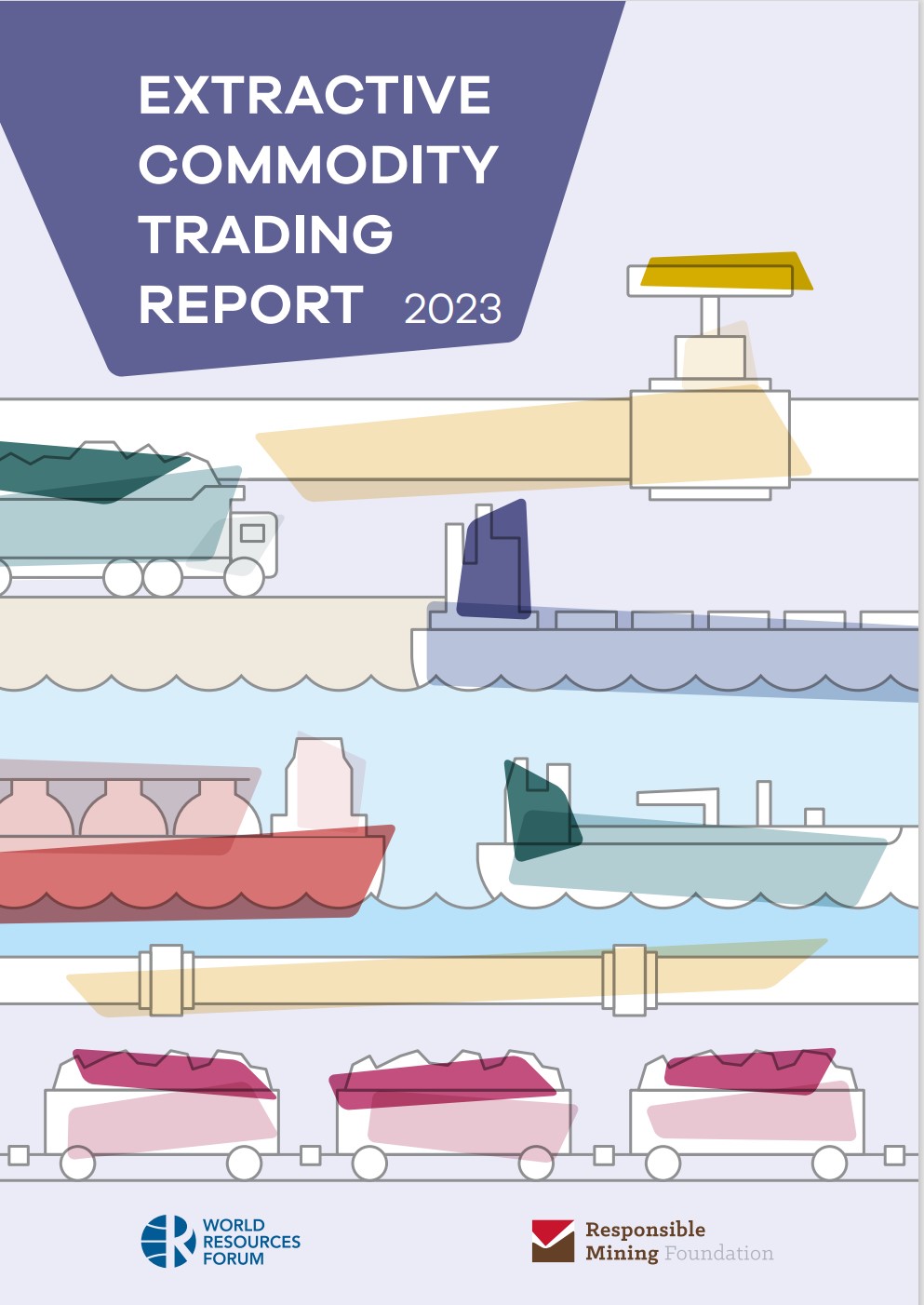
“Very few companies publish information of public interest such as their annual turnover, the taxes they pay or their purchases from governments or public enterprises. One of the reasons given by companies for non-disclosure is that financial data of this kind is highly confidential and public disclosure could harm their competitiveness”. This is one of the findings of the 2023 edition of the Extractive Commodity Trading Report, published by the World Resources Forum (WRF) and the Responsible Mining Foundation (RMF). The report assesses the ESG policies and practices of a sample of companies trading in oil, gas, minerals or metals. There has been no significant movement towards more responsible practices since the previous assessment in 2021, but the report notes that most companies have made progress on one or more indicators. Are they ready to respond to the likely increase in regulation in this traditionally opaque sector?
Trade in extractive commodities (oil and gas, metals and minerals) is critically important, not only for maintaining global flows of these resources, but also for providing many resource-rich countries with revenues essential for their economic development. Recent events have highlighted the links between the commodity trading sector and sustainable development. This can be seen, for example, in the disruption of the commodity market caused by the Covid-19 pandemic and the sanctions imposed by some countries since the start of the war in Ukraine, as well as in recent high-profile cases of bribery and corruption in the sector.
Governments, financiers, customers and consumers are increasingly aware of the need for the commodity trading industry to take more systematic action and to be transparent on economic, environmental, social and governance issues if internationally agreed goals on human rights, sustainable development and responsible financial flows are to be met, including the United Nations Sustainable Development Goals.
The Extractive Commodities Trade Report (ECTR) 2023 is an evidence-based assessment of due diligence and public disclosure among a sample of companies in the extractive commodities trading sector. Two years after the first edition of the assessment, the report continues to monitor and encourage improvement in companies’ policies and practices on responsible sourcing and public data sharing.
The assessment focuses on issues related to each company’s business operations, providing an overview of the basic steps companies are taking to: (1) manage their supply chain risks related to human rights abuses, illicit financial flows and environmental damage; and (2) publicly share data on their corporate governance, business operations and other issues of public interest.
The results of the assessment provide companies with a “gap analysis” of their current performance, indicating where improvement is most needed. More broadly, the assessment supports industry-wide learning by providing a framework that can be used by all companies in the extractive commodities trading sector and by other stakeholders (e.g. banks, investors, industry associations, etc.) to develop their own approaches to these key issues.
Companies and other stakeholders can use the findings, recommendations and learning resources in this report to improve their due diligence and public reporting. For example, the interactive library of over 1,500 documents (largely from the companies assessed) includes useful templates for tools such as supplier expectations, risk assessment questionnaires and public reporting frameworks.
Main conclusions and recommendations
[1] Most due diligence systems fall short of robust risk management
Most companies’ due diligence systems are very limited, covering little more than the initial step of defining expectations of their suppliers. Few systems extend to the critical stages of assessing supplier compliance, working with suppliers and taking action to remedy any non-compliance. This is the case for due diligence systems in the three risk areas studied: human rights abuses, illicit financial flows and environmental damage, with particularly weak evidence of environmental risk assessment and mitigation. Without these elements, due diligence systems will never contribute to the prevention of these important supply chain issues.
→ Recommendation: companies can learn from the few examples of comprehensive due diligence systems demonstrated by some of their peers.
Little effort to improve the effectiveness of due diligence systems
Very few companies can show that they verify the effectiveness of their due diligence measures. For example, around two thirds of companies show no evidence of monitoring and reporting on their performance in managing human rights risks in their supply chain. A similar proportion of companies show no evidence of monitoring and reporting on their performance in preventing illicit financial flows. Given the continued exposure of harmful practices, particularly on illicit financial flows, it is incumbent on companies to demonstrate that they are reviewing their responsible sourcing performance and seeking ways to strengthen it.
→ Recommendation: companies can improve their continuous improvement efforts by focusing more on the last two critical steps of the “plan-do-check-act” management cycle.
Some companies are debunking the myth that public disclosure undermines competitiveness
Very few companies publish information of public interest such as their annual turnover, the taxes they pay or their purchases from governments or public enterprises. One of the reasons given by companies for non-disclosure is that financial data of this kind is highly confidential and public disclosure could harm their competitiveness. Yet, on each of these issues, a some companies (private and listed on the stock exchange) demonstrate strong and voluntary disclosure. These good practices demonstrate that transparency on these issues can be considered compatible with competitiveness.
→ Recommendation: companies can follow the example of their more transparent peers to share data of public interest without compromising their competitiveness.
Anti-corruption systems are rarely supported by practical measures.
While most companies have anti-bribery and corruption (ABC) systems in place, including a compliance function and a whistleblowing mechanism, there is less evidence that companies ensure that their employees regularly fulfil their ABC responsibilities. Few companies show detailed evidence that they provide regular ABC training to their workforce. And there is no evidence that ABC performance is included in the remuneration criteria for ESG executives. These types of practical measures are essential because ABC risks are by no means hypothetical. Several companies assessed have recently been investigated or prosecuted for bribery and corruption.
→ Recommendation: Companies can improve their prevention of bribery and corruption by increasing awareness and accountability at all levels of their workforce.
Low overall progress, some individual improvements
There is no sign of a marked shift towards responsible and transparent practices. The overall average performance has increased only slightly from 33% to 34% over the last two years. Nevertheless, the majority of companies show progress on at least one issue. Improvements include, for example, new policy commitments, new management standards and greater public sharing of public interest data. At present, a few companies are performing significantly better among the companies assessed, and it is encouraging to see that some companies are beginning to catch up with their better-performing peers.
→ Recommendation: companies can use the results of this assessment to improve their due diligence practices and strengthen their public disclosure.
Companies assessed in the report
The 25 geographically dispersed companies included in the assessment have significant activities in the trade of oil, gas, metals or minerals from third parties, and include traditional trading companies, international oil companies and integrated companies (involved in both production and trade). These include : BP trading & shipping, CCI, Chevron Supply and Trading, CITIC Metal, ConocoPhillips, Eni Trade & Biofuels, ExxonMobil, Gerald Group, Glencore, Gunvor, LITASCO, Mercuria, Minmetals International, Mitsubishi Corporation, Mitsui, MRI Trading, Noble Resources, Phibro, RGL Group, Shell International Trading and Shipping, TotalEnergies Trading & Shipping, Trafigura, UNIPEC, Vitol and Wogen.
Information / Contact
commoditytrading@wrforum.org
jennifer.rietbergen@responsibleminingfoundation.org
Read the report; https://www.wrforum.org/wp-content/uploads/2023/03/ECTR-2023_WEB_Final.pdf
#Mines_Actu_Burkina